Steel Wire Rope: Types, Uses & Buying Guide (2026 Complete Guide)
This complete guide covers everything you need to know about steel wire rope — from construction types and material grades to sizing charts, industry applications, safety tips, and how to choose the right rope for your needs. Written by the technical team at Varsa Rope Wire, India’s leading wire rope manufacturer and supplier.
1. What Is Steel Wire Rope?
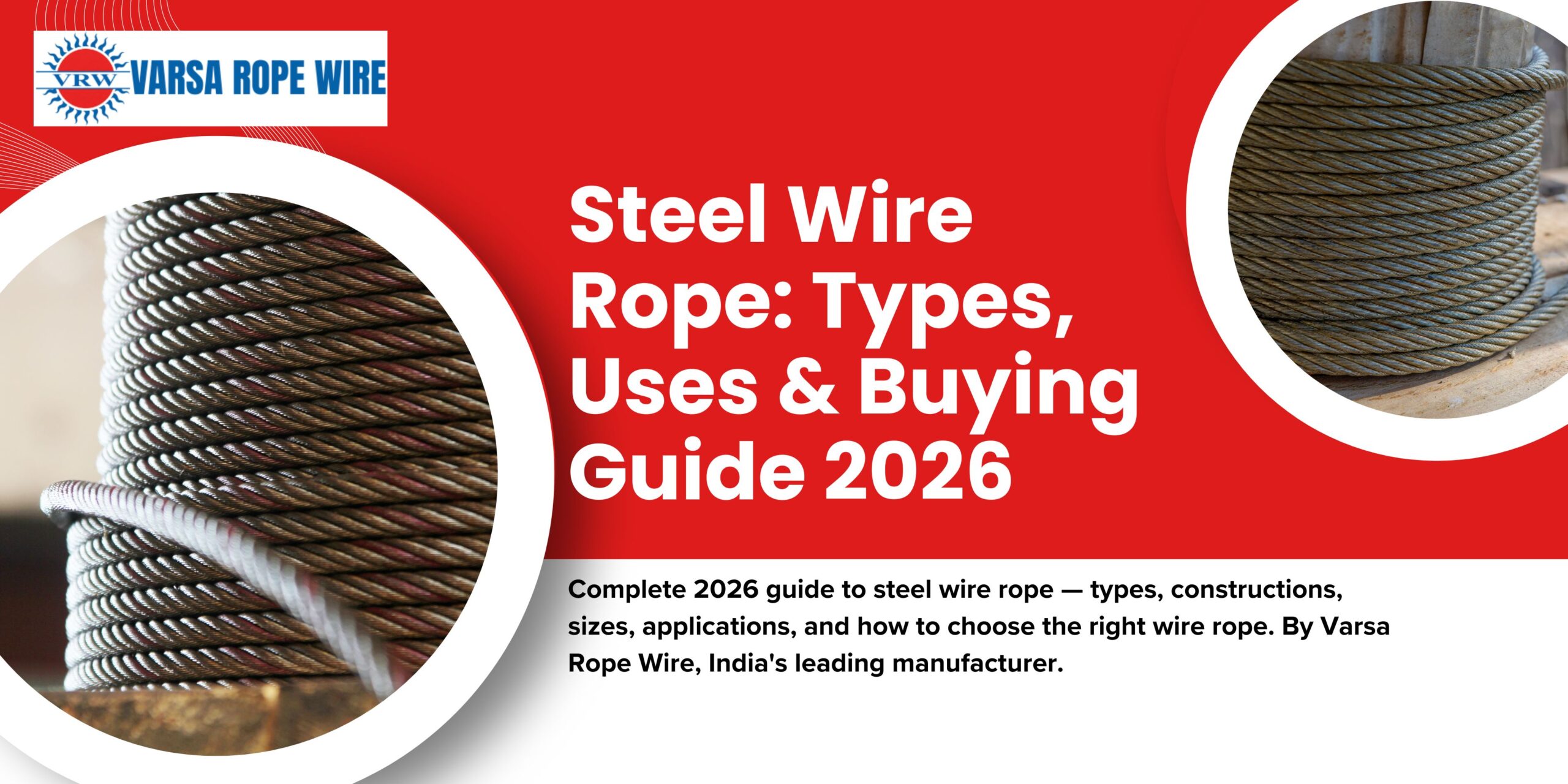
Steel wire rope — also called wire rope, steel rope, or simply wire rope — is a mechanical cable made from multiple individual steel wires twisted together to form strands, and multiple strands twisted together around a central core to form the finished rope. The result is an engineered product with extraordinary tensile strength, flexibility, durability, and fatigue resistance that no single wire could achieve on its own.
Steel wire rope has been the backbone of industrial lifting, hoisting, rigging, and tensioning for over 180 years. In India today, steel wire rope is used in virtually every major industry — from construction cranes and mine hoists to suspension bridges, elevators, offshore oil platforms, and architectural cable railings.
How Is Steel Wire Rope Made?
The manufacturing process follows three stages:
- Wire Drawing — High-carbon steel rod is drawn through progressively smaller dies to produce individual steel wires of the required diameter and tensile grade.
- Stranding — Multiple individual wires are twisted together helically to form a strand. The number and arrangement of wires determines the rope’s flexibility and abrasion resistance.
- Closing (Roping) — Multiple strands are twisted together around a central core (Fiber Core or Independent Wire Rope Core) to produce the finished wire rope.
Key Components of Steel Wire Rope
- Individual Wires — The smallest element; made from high-carbon or stainless steel
- Strands — Groups of wires twisted together in a helical pattern
- Core — The central element around which strands are laid; either Fiber Core (FC) or Independent Wire Rope Core (IWRC)
- Lay Direction — The direction the strands twist (right-hand lay is most common in India)
- Lay Type — Regular lay (wires and strands twist opposite directions) or Lang’s lay (same direction)
💡 Pro Tip: Steel wire rope should not be confused with chain, synthetic rope, or fiber rope. For heavy industrial lifting, crane operations, and mine hoisting in India, only certified steel wire rope should be used.
2. Types of Steel Wire Rope
Steel wire rope is classified by its material, surface treatment, and construction. Understanding the different types of wire rope is the first step in selecting the right product for your application. Here are the main types of steel wire rope available from Varsa Rope Wire:
2.1 Galvanized Wire Rope
Galvanized wire rope is the most widely used type of steel wire rope in India. The individual steel wires are coated with zinc through a hot-dip galvanizing process before being stranded and roped. The zinc coating provides a physical and electrochemical barrier against rust and corrosion, making galvanized wire rope suitable for outdoor, construction, mining, and general industrial applications.
- Hot-dip galvanized wire rope — thicker zinc coating; maximum corrosion protection
- Electro-galvanized wire rope — thinner zinc coating; lighter duty corrosion protection
- Available in all standard constructions: 6×7, 6×19, 6×36, 6×61, 19×7, 35×7
- Standard compliance: IS:2266, BS:302, DIN 3060
2.2 Stainless Steel Wire Rope (SS Wire Rope)
Stainless steel wire rope — commonly called SS wire rope or ss wire — is made from stainless steel alloy rather than carbon steel. The corrosion resistance is inherent in the alloy itself (through a passive chromium oxide layer), not dependent on a coating. This makes stainless steel wire rope the premium choice for environments where galvanized rope would corrode too quickly.
- Grade 304 Stainless Steel Wire Rope (304 SS wire) — excellent general corrosion resistance; suitable for indoor, freshwater, and mild outdoor applications
- Grade 316 Stainless Steel Wire Rope (316 SS wire) — superior corrosion resistance due to added molybdenum; the standard for marine, coastal, and chemical environments
- Available in 7×7, 7×19, 1×19, 6×19, and other constructions
- 3mm stainless steel wire rope is particularly popular for architectural railings and marine applications in India
2.3 PVC Coated Wire Rope
PVC coated wire rope is a galvanized or stainless steel core wire rope with an extruded polyvinyl chloride (PVC) jacket applied over the outside. The PVC coating adds an additional layer of corrosion, UV, and abrasion protection, while providing a smooth, clean surface that is safe to handle and does not mark surrounding materials.
- Available with galvanized core (budget-friendly) or stainless steel core (maximum protection)
- Colours: black, green, white, red, yellow, custom
- Popular sizes: 2mm, 3mm, 4mm, 5mm, 6mm, 8mm, 10mm coated wire rope
- Applications: cable railings, garden/horticulture, marine barriers, car parks, sports facilities
2.4 IWRC Wire Rope (Independent Wire Rope Core)
IWRC wire rope features a core made from a separate small wire rope (instead of a fiber core). This gives the rope superior crush resistance, higher metallic cross-section, and greater load-bearing capacity — critical factors in demanding industrial applications like mining hoists, offshore cranes, and heavy construction equipment.
- 5% higher metallic cross-section than same-diameter fiber core rope
- Superior resistance to crushing and deformation on multi-layer drums
- Recommended for all heavy crane, mining, and offshore applications
- Available in all major constructions: 6×19 IWRC, 6×36 IWRC, 19×7, 35×7
2.5 Ungalvanized (Bright) Wire Rope
Ungalvanized or bright wire rope is plain carbon steel wire rope with no surface coating. It offers the highest tensile strength of all wire rope types but has minimal corrosion resistance. It is suited only for dry indoor environments, temporary applications, and situations where maximum strength-to-weight ratio is the priority.
Here is a quick comparison of all wire rope types:
| Type | Core Material | Corrosion Resist. | Strength | Best For |
| Galvanized Wire Rope | Carbon Steel + Zinc | Good (Zinc coated) | Very High | Construction, mining, general lifting |
| Stainless Steel (SS) Wire Rope | SS Grade 304 / 316 | Excellent (inherent) | High | Marine, food, chemical, architectural |
| PVC Coated Wire Rope | Galvanized or SS + PVC | Excellent (dual layer) | High | Architecture, garden, marine, sports |
| IWRC Wire Rope | Independent Wire Rope Core | Good to Excellent | Highest | Cranes, mining hoists, offshore |
| Ungalvanized (Bright) Steel Rope | Carbon Steel | Low (no coating) | Highest | Dry indoor use, temporary applications |
3. Wire Rope Constructions Explained
Wire rope construction describes how many strands and how many wires per strand the rope contains. This is one of the most critical factors in determining a wire rope’s flexibility, abrasion resistance, fatigue life, and suitability for specific applications. The construction is written as two numbers — for example, 6×19 means 6 strands with approximately 19 wires per strand.
How to Read Wire Rope Construction Notation
6×19: 6 strands | ~19 wires per strand | balanced flexibility and abrasion resistance
6×36: 6 strands | ~36 wires per strand | higher flexibility, lower abrasion resistance
7×7: 7 strands | 7 wires per strand | semi-flexible, good abrasion resistance
7×19: 7 strands | 19 wires per strand | high flexibility, commonly used for elevator and running rigging
1×19: Single strand | 19 wires | very rigid, maximum abrasion resistance; used for standing rigging
35×7: 35 strands | 7 wires each | rotation-resistant; used for tower cranes and single-fall lifts
Here is the complete wire rope construction comparison table:
| Construction | Strands x Wires | Flexibility | Abrasion Resist. | Core Type | Typical Application |
| 6×7 | 6 x 7 wires | Low | Very High | FC / IWRC | Guy wires, haulage, standing rigging |
| 6×19 | 6 x 19 wires | Medium | High | FC / IWRC | EOT cranes, hoists, general lifting |
| 6×36 | 6 x 36 wires | High | Medium | FC / IWRC | Tower cranes, mobile cranes, elevators |
| 7×7 | 7 x 7 wires | Medium | High | Wire core | Cable railings, marine, architectural |
| 7×19 | 7 x 19 wires | Very High | Medium | Wire core | Elevator ropes, running rigging, flexible uses |
| 1×19 | 1 strand x 19 | Very Low | Highest | None (solid strand) | Standing rigging, cable railings, stays |
| 19×7 | 19 x 7 wires | High | Medium | IWRC | Crane hoisting, mine winders |
| 35×7 (Rotation Resistant) | 35 x 7 wires | High | Medium | IWRC | Tower cranes, single-fall lifts (non-spinning) |
💡 Pro Tip: For crane applications in India, 6×19 IWRC is the most commonly specified construction for standard duty cranes. For higher duty cycles and mobile cranes, 6×36 IWRC is preferred. For tower cranes and single-fall lifts, rotation-resistant 35×7 is recommended.
4. Wire Rope Sizes & Safe Working Load Chart
Selecting the correct wire rope size (diameter) is critical for safety and performance. The right diameter depends on the load to be lifted or supported, the safety factor required, the type of equipment (crane, hoist, elevator), and the relevant Indian or international standard.
Wire Rope Size: How Is It Measured?
Wire rope diameter is always measured at the widest point of the rope cross-section — from crown to crown of the outermost strands — using a calliper or wire rope gauge. Always measure a new, tensioned rope to get an accurate reading.
Standard Wire Rope Sizes Available from Varsa Rope Wire
| Diameter | Approx. Weight (kg/m) | Breaking Load (tonnes) | Safe Working Load (SWL)* | Typical Use |
| 3mm | 0.04 | 0.6 | 0.12 | Cable railings, safety lines, garden |
| 4mm | 0.07 | 1.0 | 0.20 | Light rigging, marine, architecture |
| 6mm | 0.16 | 2.5 | 0.50 | Small hoists, boat rigging |
| 8mm | 0.28 | 4.5 | 0.90 | Wire rope slings, construction rigging |
| 10mm | 0.44 | 7.0 | 1.40 | Construction cranes, lifting cables |
| 12mm | 0.63 | 10.0 | 2.00 | EOT cranes, gantry cranes, hoists |
| 16mm | 1.13 | 18.0 | 3.60 | Heavy construction, ship cranes |
| 20mm | 1.76 | 28.0 | 5.60 | Large cranes, port equipment |
| 24mm | 2.53 | 40.0 | 8.00 | Heavy crane wire rope, offshore |
| 32mm | 4.50 | 72.0 | 14.4 | Mine hoists, deep shaft mining |
| 40mm | 7.05 | 110.0 | 22.0 | Extra heavy mining, oilfield |
*SWL is calculated at a Design Factor (safety factor) of 5:1 as per IS:3973 for general lifting. Actual SWL may vary depending on rope construction, termination efficiency, and application. Always consult a qualified engineer.
💡 Pro Tip: Varsa Rope Wire supplies wire rope from 3mm to 64mm diameter and beyond. Custom sizes and lengths are available for OEM and project-specific requirements. Contact us at varsaropewire.com for a detailed technical datasheet.
5. Industry Applications of Steel Wire Rope
Steel wire rope is one of the most versatile industrial materials in existence. Its combination of high tensile strength, flexibility, fatigue resistance, and adaptability to different constructions and coatings makes it suitable for an enormous range of applications across India’s industrial landscape.
5.1 Construction Industry
India’s construction boom — residential high-rises, commercial complexes, metro rail, highways, and smart city infrastructure — is the single largest consumer of steel wire rope in the country. Construction applications include:
- Crane wire rope for tower cranes, mobile cranes, EOT cranes, and crawler cranes
- Wire rope slings for steel erection, precast element lifting, and material handling
- Hoist rope for construction material and personnel hoists
- Lifting cables for formwork systems and shoring equipment
- Temporary works: guy wires, tie-backs, and bracing systems
5.2 Mining Industry
Mining is the most demanding wire rope application environment in India — continuous cyclic loading, abrasion, moisture, and shock loads are the norm. Mining applications include:
- Mine shaft hoisting rope: IWRC wire rope in 28mm–64mm for deep shaft hoists
- Dragline and excavator rope: extra-heavy IWRC for surface mining equipment
- Inclined hoist and slope winder rope
- Underground conveyor and face equipment rope
- Rock bolting and ground support cable systems
5.3 Marine & Offshore Industry
India’s 7,500km coastline, major ports, and growing offshore oil & gas sector create significant demand for corrosion-resistant wire rope:
- Vessel mooring lines and towing hawsers
- Ship crane and deck crane wire rope
- Offshore platform crane rope (API 9A specification)
- Stainless steel wire rope (Grade 316) for standing rigging on vessels
- PVC coated wire rope for marina railings and coastal safety systems
5.4 Elevator & Escalator Industry
Elevators depend on high-flexibility, high-fatigue wire rope that can withstand thousands of bending cycles daily while meeting strict safety standards:
- Elevator traction rope: 6×19 or 8×19 construction in 8mm–16mm
- Must comply with IS:3973 (India) and EN 81 (international)
- High flexibility required to work on small traction sheaves
- Pre-formed wire rope recommended for elevator applications
5.5 Oil & Gas Industry
- Drilling line for rotary drilling rigs (API 9A specification)
- Sand line and measuring line for well services
- Platform crane rope for offshore installations
- Pipeline pulling and laying operations
5.6 Infrastructure & Bridges
- Stay cables for cable-stayed bridges
- Suspension bridge main cables and hangers
- Architectural cable tensioning systems
- Cable railings and balustrades for pedestrian bridges and public spaces
- Overhead line tensioning for railways and highways
5.7 Agriculture & Horticulture
- Greenhouse support wires and trellis systems
- PVC coated green wire rope for vineyard and orchard training
- Farm fencing and enclosure systems
- Grain elevator and agricultural hoist applications
Here is a quick-reference application guide for selecting the right wire rope:
| Application | Recommended Type | Construction | Size Range | Core |
| EOT / Gantry Crane | Galvanized Wire Rope | 6×19 or 6×36 | 12–24mm | IWRC |
| Tower Crane | Galvanized Wire Rope | 6×36 or 35×7 | 16–32mm | IWRC |
| Mobile Crane | Galvanized Wire Rope | 6×36 | 16–28mm | IWRC |
| Elevator / Lift | Galvanized Wire Rope | 6×19 or 8×19 | 8–16mm | FC |
| Marine / Coastal | SS Grade 316 Wire Rope | 7×7 or 7×19 | 4–20mm | Wire |
| Architectural Railings | SS 304/316 or PVC Coated | 1×19 or 7×7 | 3–8mm | Wire |
| Mining Hoist | IWRC Galvanized Wire Rope | 6×36 or 19×7 | 24–64mm | IWRC |
| Oil & Gas / Drilling | IWRC (API 9A spec) | 6×19 or 6×26 | 16–44mm | IWRC |
| Cable Railing / Balustrade | SS 304 or PVC Coated | 1×19 or 7×7 | 3–6mm | Wire |
| General Industrial Rigging | Galvanized Wire Rope Slings | 6×19 | 8–20mm | FC/IWRC |
6. Galvanized vs Stainless Steel vs PVC Coated Wire Rope — Full Comparison
Choosing between the three main types of wire rope available in India can be challenging. Here is a comprehensive side-by-side comparison to help you decide:
| Criteria | Galvanized Wire Rope | Stainless Steel Wire Rope | PVC Coated Wire Rope |
| Corrosion Resistance | Good (zinc coating) | Excellent (alloy inherent) | Excellent (dual protection) |
| Tensile Strength | Very High | High | High (steel core same) |
| Flexibility | Medium to High | Medium to High | Medium to High |
| Cost | Low–Medium | Medium–High (3–5x galv.) | Medium |
| Appearance | Dull silver-grey | Bright, polished silver | Smooth, multiple colours |
| Maintenance | Needs lubrication | Minimal | Minimal |
| Saltwater Suitability | Moderate | Excellent (Grade 316) | Excellent |
| Indoor/Dry Use | Excellent | Excellent | Excellent |
| Best Environments | Construction, mining | Marine, food, architecture | Garden, marine, sport, architecture |
| Indian Standard | IS:2266 | IS:2266 / ASTM | IS:2266 (core) |
Quick Decision Rule: For construction and heavy industry → Galvanized. For marine, coastal, food, and architecture → Stainless Steel 316. For garden, decorative, sports, and pool areas → PVC Coated. Not sure? Contact Varsa Rope Wire for a free technical recommendation.
7. How to Choose the Right Steel Wire Rope — Step-by-Step Buying Guide
Selecting the correct wire rope is a multi-factor decision. The wrong choice can lead to premature rope failure, equipment damage, or — in worst cases — serious accidents. Here is a step-by-step buying guide to help you make the right decision.
Step 1: Define Your Load Requirements
- What is the maximum load (in tonnes or kg) that the rope must safely support or lift?
- Apply the required safety factor (Design Factor): minimum 5:1 for general lifting per IS:3973
- Calculate minimum breaking load = Maximum Load x Safety Factor
- Select a rope diameter with breaking load meeting or exceeding this value (use size chart in Section 4)
Step 2: Assess Your Operating Environment
- Dry indoor environment with no moisture → Ungalvanized or galvanized wire rope is suitable
- Outdoor or moderate humidity → Hot-dip galvanized wire rope recommended
- Marine, coastal, or saltwater exposure → Grade 316 stainless steel wire rope required
- Chemical or food processing environment → Grade 316 SS wire rope or PVC coated wire rope
- Architectural, decorative, or visible installations → Stainless steel or PVC coated wire rope
Step 3: Choose the Right Construction
- Stationary or low-movement use (guy wires, stays) → 6×7 or 1×19 construction
- Standard crane and general lifting → 6×19 IWRC
- High-cycle cranes, mobile cranes, elevators → 6×36 IWRC
- Rotation-sensitive single-fall lifts, tower cranes → 35×7 rotation-resistant
- Cable railings and architecture → 1×19 or 7×7 stainless
- Small marine and light duty → 7×7 or 7×19
Step 4: Select the Core Type
- Fiber Core (FC) — suitable for hand-operated equipment, lower duty cycles, and applications with larger D/d ratios
- IWRC (Independent Wire Rope Core) — required for crane hoisting, mine hoists, multi-layer drum winding, and all heavy-duty applications
Step 5: Verify Sheave and Drum Compatibility
- D/d ratio (drum or sheave diameter ÷ rope diameter) must meet minimum values per IS:3973
- 6×19 rope: minimum D/d ratio of 26:1 recommended for good rope life
- 6×36 rope: minimum D/d ratio of 18:1 recommended
- Always check that your wire rope pulley and wire rope sheave groove radius matches the rope diameter (groove radius = ~0.53 x rope diameter)
Step 6: Check the Relevant Standard
- General lifting in India: IS:2266 (steel wire rope) and IS:3973 (crane rope)
- Elevator rope: IS:3973 and EN 81
- Mining: DGMS (Directorate General of Mines Safety) regulations
- Oil & gas: API 9A and RP 9B
- Marine: ISO 2408 and relevant class society rules
Step 7: Specify Your Requirements to Your Supplier
When ordering from Varsa Rope Wire, provide the following information for the most accurate quotation and fastest delivery:
- Rope diameter (mm)
- Construction (e.g. 6×19 IWRC)
- Material type (galvanized / SS 304 / SS 316 / PVC coated)
- Total length required (metres)
- Applicable standard (IS:2266, IS:3973, API 9A, etc.)
- Application description (crane type, hoist capacity, environment)
💡 Pro Tip: The technical team at Varsa Rope Wire provides free wire rope selection consultations. Contact us at varsaropewire.com/contact-us/ with your equipment specifications and we will recommend the exact product for your needs.
8. Wire Rope Safety & Maintenance Tips
Even the highest-quality steel wire rope will fail prematurely if not properly inspected, maintained, and retired at the right time. Here are the essential safety and maintenance guidelines for all wire rope users in India.
8.1 Regular Inspection — What to Look For
Indian standards (IS:3973, IS:2266) and DGMS regulations require periodic inspection of wire rope in service. Key inspection points include:
- Broken wires — Count broken wires over a rope length of 6 diameters. More than 6 broken wires in one strand, or 10 in the whole rope, typically requires immediate retirement.
- Reduction in rope diameter — A decrease of more than 3% from nominal diameter indicates internal wire breakage or core deterioration.
- Corrosion — Surface or internal corrosion reduces strength dramatically. Reddish-brown surface staining, pitting, or flaking are serious signs.
- Kinks and bends — A kinked wire rope must be replaced immediately. Kinks cause localised stress concentration and will fail suddenly under load.
- Birdcaging — Strands and wires spreading away from the rope body indicate a rope that has been shock-loaded; retire immediately.
- Core damage or protrusion — If the core is visible or protruding through the strands, the rope must be replaced.
- Heat damage — Discolouration, brittleness, or loss of lubrication indicates heat exposure; retire the rope.
8.2 Lubrication — Extending Rope Service Life
Most wire rope is factory-lubricated, but this lubrication is depleted over time in service. Regular re-lubrication dramatically extends rope service life by reducing internal friction, preventing internal corrosion, and protecting against moisture penetration.
- Use the correct wire rope lubricant — penetrating lubricants (lower viscosity) for running ropes; coating lubricants for standing ropes
- Apply lubricant when the rope is in motion — this allows penetration into the rope core
- Frequency: at minimum every 3 months for outdoor/exposed ropes; every 6 months for sheltered applications
- Avoid over-lubrication that attracts dirt and accelerates abrasive wear
8.3 Correct Installation and Handling
- Always unspool wire rope from a reel or drum — never from a coil laid flat; this causes kinking
- Use wire rope clips correctly — minimum number of clips, saddle on live end, correct torque values (per IS:2905 / DIN 741)
- Never use kinked, birdcaged, or heat-damaged rope — discard and replace
- Use thimbles in all looped eye terminations to protect the rope from sharp bends at shackle pins
- Never apply sudden shock loads — always take up load gradually
- Never allow rope to run over sharp edges without proper sheaves or fairleads
8.4 Storage Guidelines
- Store on a clean, dry surface — keep off the ground on a reel or wooden battens
- Protect from direct sunlight, moisture, chemicals, and extreme temperatures
- Re-lubricate before extended storage periods
- First-in, first-out (FIFO) stock rotation — use older stock before new
💡 Pro Tip: Wire rope that has been in storage for more than 12 months without lubrication should be inspected and re-lubricated before use. Always check for corrosion or moisture damage before deploying stored rope on a critical lifting application.
9. Wire Rope Standards in India
All wire rope used in Indian industry must comply with the relevant Bureau of Indian Standards (BIS) specifications, as well as the applicable regulatory requirements for the specific sector. Below are the key standards governing steel wire rope in India:
- IS:2266 — Steel Wire Ropes for General Engineering Purposes: Covers construction, dimensions, mechanical properties, and testing of standard steel wire ropes. This is the primary Indian Standard for wire rope.
- IS:1855 — Steel Wire Ropes for Lifts, Elevators and Hoists: Governs wire rope used in elevator and hoisting equipment.
- IS:3973 — Selection, Installation, and Maintenance of Wire Ropes: Code of practice for crane and hoist rope selection, installation, and maintenance. Critical reference for crane operators and rigging professionals.
- IS:4594 — Endless Wire Rope Slings: Standard for wire rope slings used in lifting and rigging.
- IS:7216 — Wire Rope Slings — Safety: Safety requirements for wire rope slings.
- DGMS Circular — Director General of Mines Safety: Mandatory regulations for wire rope used in Indian coal and metal mines.
- API 9A / RP 9B — Specification for Wire Rope (Oil & Gas): American Petroleum Institute standards for drilling line and oilfield wire rope, widely referenced by Indian oil & gas operators.
- ISO 2408 — Steel Wire Ropes for General Purposes: International standard referenced for export and marine applications.
All steel wire rope supplied by Varsa Rope Wire is manufactured to IS:2266 and other applicable Indian and international standards. Test certificates and material certifications are available on request for all products.
10. Why Choose Varsa Rope Wire — India’s Leading Wire Rope Manufacturer?
With hundreds of wire rope suppliers operating in India, choosing the right partner makes a significant difference to the quality, reliability, and cost of your wire rope supply. Here is why thousands of Indian industries trust Varsa Rope Wire:
Pan-India Supply Network
Varsa Rope Wire supplies steel wire rope to all 28 states and 8 union territories across India — from Andaman and Nicobar Islands to Ladakh, from Gujarat to West Bengal. Whether you are searching for wire rope suppliers near me in Chennai, Mumbai, Delhi, Hyderabad, Kolkata, Pune, or any other city — we deliver to your site.
Complete Product Range
- All types: galvanized, stainless steel (304 & 316), PVC coated, IWRC, rotation-resistant
- All constructions: 6×7, 6×19, 6×36, 7×7, 7×19, 1×19, 19×7, 35×7 and more
- All sizes: 3mm to 64mm and above
- All accessories: wire rope clips, rope clips, wire rope slings, wire rope pulleys, wire rope sheaves, thimbles, swage fittings, turnbuckles
IS & International Standard Compliance
Every product we supply is manufactured to IS:2266, IS:1855, IS:3973, and other applicable standards. API 9A, DIN, BS, and ISO grade rope available for international-standard projects.
Technical Expertise
Our technical team provides free rope selection consultations, load calculation support, and maintenance guidance. We do not just sell rope — we help you select the right product and use it safely and efficiently.
Competitive Pricing & Bulk Supply
As a direct manufacturer and bulk rope supplier, we eliminate middlemen to offer the best prices for both small orders and large-scale project supply contracts. Bulk rope orders for mining, ports, and large construction projects are a speciality.
Fast Delivery Across India
We maintain large ready stock of the most popular wire rope types, sizes, and constructions and can fulfil standard orders within 24–48 hours from our distribution network, with delivery to any location in India.
Contact Varsa Rope Wire: Visit varsaropewire.com/contact-us/ or explore our products at varsaropewire.com/our-products/ — our team is ready to help you find the right wire rope solution for your application.
11. Frequently Asked Questions About Steel Wire Rope
Q1. What is the difference between steel wire rope and steel cable?
In most industrial and engineering contexts in India, ‘steel wire rope’ and ‘steel cable’ are used interchangeably to refer to the same product — a rope made from multiple steel wires twisted into strands, and strands twisted around a core. Strictly speaking, ‘cable’ can sometimes refer to locked-coil or spiral strand products used in structural applications, but in everyday usage both terms describe the same product category.
Q2. What is the safe working load (SWL) of wire rope?
The Safe Working Load (SWL) is the maximum load that a wire rope may safely carry during normal operation. It is calculated by dividing the rope’s minimum breaking load by the required Design Factor (safety factor). For general lifting in India per IS:3973, a Design Factor of 5:1 is standard — meaning a rope with a breaking load of 50 tonnes has an SWL of 10 tonnes. SWL must always be marked on wire rope slings and lifting equipment.
Q3. How long does steel wire rope last?
Service life depends on the application, operating conditions, maintenance schedule, and rope quality. A well-maintained crane wire rope in a standard duty application may last 6–18 months. Mining hoist rope may be replaced more frequently due to high cycles and regulatory requirements. Architectural stainless steel wire rope, if properly specified and installed, can last 20+ years. Regular inspection and timely re-lubrication dramatically extend rope service life.
Q4. What is IWRC wire rope and when do I need it?
IWRC stands for Independent Wire Rope Core — a type of wire rope where the central core is itself a small wire rope rather than a fiber (sisal or polypropylene) core. IWRC wire rope has approximately 7.5% higher metallic cross-section, superior crush resistance on multi-layer drums, and better performance in severe operating conditions. It is required for all crane hoisting, mine hoisting, and offshore lifting applications where high load, high cycle, or multi-layer drum winding is involved.
Q5. What is the difference between 6×19 and 6×36 wire rope?
6×19 wire rope has 6 strands with approximately 19 wires per strand. It offers good abrasion resistance and moderate flexibility — suited for standard cranes and general lifting. 6×36 wire rope has 6 strands with approximately 36 wires per strand. The finer wires give it greater flexibility, better fatigue life under high bending cycles, and suitability for smaller sheave diameters — making it preferred for tower cranes, mobile cranes, and high-cycle hoists.
Q6. Which wire rope is best for a crane in India?
For standard industrial cranes (EOT, gantry, jib) in India, 6×19 IWRC galvanized wire rope complying with IS:3973 is the most commonly used specification. For tower cranes and high-cycle mobile cranes, 6×36 IWRC or 35×7 rotation-resistant wire rope is recommended. The correct diameter depends on the crane’s rated capacity — refer to the size chart in Section 4 of this guide.
Q7. Can I use galvanized wire rope near the sea?
Galvanized wire rope can be used in mild coastal environments with regular maintenance and re-lubrication. However, for prolonged exposure to saltwater spray, salt fog, or marine immersion, Grade 316 stainless steel wire rope is strongly recommended for reliable long-term performance. The zinc coating on galvanized rope will be consumed over time in aggressive saltwater environments.
Q8. What wire rope do I need for a cable railing / balustrade?
For cable railings and balustrades in India, 3mm to 6mm stainless steel wire rope in 1×19 or 7×7 construction is standard. Grade 316 is preferred for outdoor, coastal, or poolside installations. PVC coated wire rope in the same diameter range is a cost-effective alternative for garden and indoor architectural applications.
Q9. Do you supply wire rope in custom lengths?
Yes. Varsa Rope Wire supplies wire rope cut to any length required, from a few metres to full reel lengths of several thousand metres. We also supply wire rope in standard coil lengths or on returnable reels for large orders. Contact us at varsaropewire.com/contact-us/ for custom length pricing.
Q10. What certifications do you provide with your wire rope?
Varsa Rope Wire provides material test certificates (MTC), dimensional inspection reports, and third-party laboratory test reports on request. For mining applications, DGMS-compliant documentation is available. For oil & gas, API 9A certificates are available. For export orders, certificates to DIN, BS, or ISO standards can be supplied.
Ready to Buy? Get a Free Quote from India’s Best Wire Rope Supplier
Whether you are a first-time buyer trying to understand what steel wire rope is right for your project, or a procurement manager sourcing thousands of metres of crane wire rope for a major infrastructure job — Varsa Rope Wire has the expertise, the stock, and the pan-India reach to deliver.
Visit varsaropewire.com to browse our complete product range, request a technical consultation, or get an instant quote. We supply all types of steel wire rope — galvanized, stainless steel, PVC coated, and IWRC — in all sizes and constructions, to all Indian states.
Our team of wire rope specialists is ready to help you choose the right type, construction, and size for your application — at the right price, delivered on time, anywhere in India.